Short answer: drainage SEO works when your pages match how a homeowner thinks, which is problem first, solution second. That means a page for each common wet-yard problem that explains the causes honestly, a page for each solution you install, real job photos, a Business Profile that represents how you actually serve customers, and area pages only where you have something specific to say. Drainage contractors, French drain installers and yard drainage companies all compete on the same searches, so the clearest pages win.
Why Drainage Search Is a Problem-First Search
Most home-service trades sell something the customer already knows they need. A drainage contractor sells the fix to a problem the customer is still trying to name. Nobody wakes up wanting a French drain. They wake up to a backyard that is still a swamp three days after the rain, a basement window well that fills, or a patch of lawn that never dries. The search starts with the symptom, and the company that explains the symptom clearly is usually the company that gets the call.
That changes how a drainage site should be built. A single “Drainage Services” page that lists every service in a paragraph answers none of the questions a worried homeowner has. The pages that rank and convert are specific: one for each common problem, one for each solution you install, and a clear path from one to the other.
The Searches That Bring In Drainage Customers
Search volume for drainage terms is modest in most towns and spikes after storms. The demand is spread across problem phrases, solution phrases and place names, so the right plan covers all three rather than betting on one keyword. These are the patterns we build pages around:
| Search pattern | Examples | What it means |
|---|---|---|
| Problem searches | “water pooling in backyard,” “standing water in yard after rain,” “wet spot in lawn won’t dry,” “water against foundation” | The largest pool of demand and the earliest in the decision. The searcher often does not know which fix they need yet. |
| Solution searches | “French drain installation,” “yard drainage contractor,” “channel drain,” “dry well installation,” “downspout drainage” | Higher intent. These readers are comparing contractors, so they need your process, photos and proof. |
| Service + place | “drainage contractor [town],” “yard drainage near me,” “French drain [county]” | Where the Business Profile and your service-area pages do the work. |
| Cause searches | “why is my yard always wet,” “clay soil drainage problems,” “neighbor’s water running onto my property” | Good for one honest explainer each. Some readers will fix it themselves; the rest will call. |
| DIY searches | “how to install a French drain,” “how deep should a French drain be” | Worth one careful page. It builds trust, and a reader who sees how much work it is may hire you. |
Use your customers’ words. Homeowners say “standing water,” “soggy yard” and “wet spot,” and trade vocabulary like “surface drainage” or “subsurface drain” belongs in the explanation, not the headline. Your own Search Console data will show which phrasing your market uses. Our keyword research guide walks through how to find it.
Problem Pages: Explain the Water Before You Sell the Fix
A good problem page does four things. It names the symptom in the reader’s words, lists the common causes in plain language, tells them how to check which one applies, and then says which solutions fit each cause. That last part is what separates a useful page from a sales page. A homeowner whose problem is a clogged downspout does not need a French drain, and a page that says so earns trust for the next search.
Typical causes worth covering honestly are roof and gutter runoff dumped next to the house, ground that slopes toward the building, compacted or clay-heavy soil that drains slowly, a low spot where water collects, and water arriving from a neighbor’s property or a street. Each has a different remedy, and some are simple. Include what the homeowner can check themselves, such as where the downspouts discharge and where water goes during a storm, because the reader who does that check arrives at your contact form better informed.
Keep the claims modest. Whether a drain solves a problem depends on grading, soil and the volume of water, and you cannot promise a dry yard from a web page. Say what a site visit looks at: slope, soil, where water enters and where it can go. That is the honest answer, and it is also the one that makes the visit feel necessary rather than salesy.
Solution Pages: One for Each Thing You Install
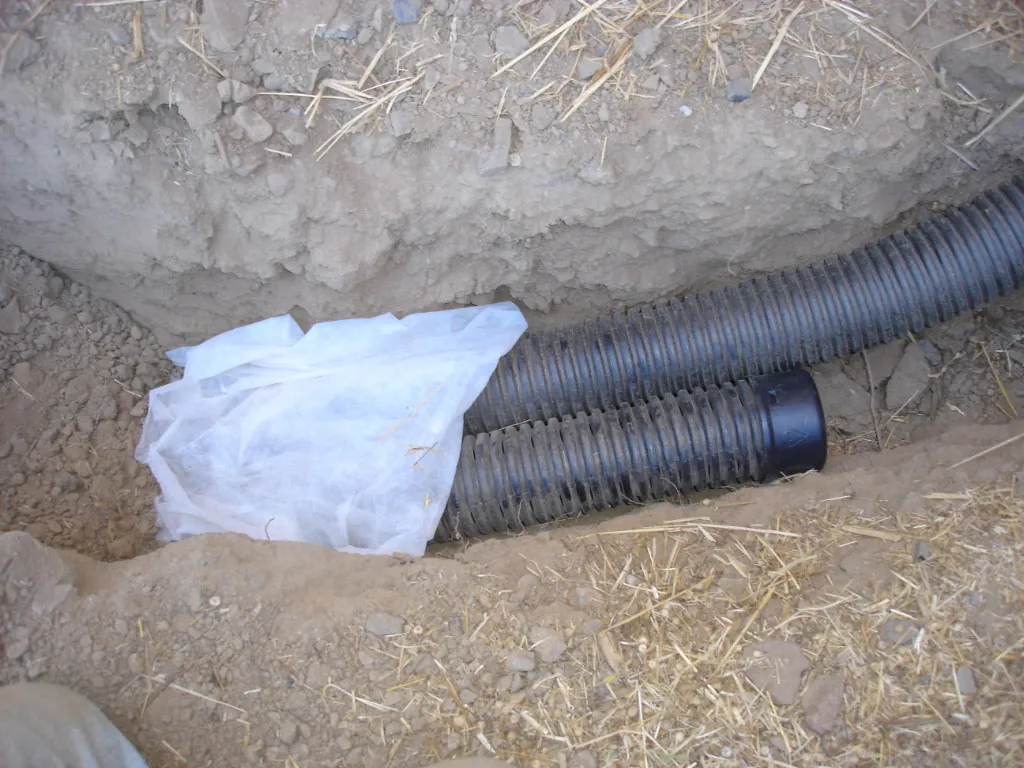
Solution pages catch the reader who has already done the research. They should explain what the system is, how it works, where the water goes at the end, and what the job involves. The public-domain French drain photo on this page, taken in the field, shows the basic anatomy: a trench lined with landscape fabric, base rock, a drain pipe and more rock on top. A page that explains those layers and why each one is there reads as expertise.
Cover each solution you actually sell, and only those. A typical set for the trade is French drains, channel or trench drains, surface grading, dry wells and downspout extension or burial. If you do not install it, leave it off, because a page for a service you cannot deliver brings calls you cannot take. Link each solution page to the problem pages it fits, and link between solutions that are often combined.
Show real jobs. A project page with before-and-after photos, the problem description, the approach and where the water now goes does more than any paragraph of copy. Get the customer’s permission, caption the photos with what they show, and write the page as a short case rather than an advertisement. The website must-haves guide covers the photo and trust elements every trade site needs.
Want to see what your drainage site is missing?
We review the pages, profile and reviews that decide who gets the call, and send you a prioritized list. Free, and yours to keep.
Get Your Free Drainage SEO AuditYour Google Business Profile and Service Area
Most drainage contractors work at the customer’s property and do not run a storefront. Google’s Business Profile guidelines address this: a business that serves customers at their location can hide its address and list service areas instead, and the profile has to represent the real business, with the real name, real service areas and a real way to reach it. Read the current guidelines before you set it up, because they are updated and suspensions for misrepresentation are a real cost.
Pick the primary category that best describes the core of the business from the category list shown in your profile, then add secondary categories for services you really perform. Add services and descriptions that match your solution pages, upload real job photos regularly and answer questions as they come in. Google has said that local results are ranked mainly on relevance, distance and prominence, so a complete, accurate profile helps relevance, a real service area helps distance, and reviews and links help prominence. Our Business Profile guide covers setup in detail, and the map pack guide covers what moves rankings.
Service-Area Pages Without the Thin-Page Trap
It is tempting to publish a page for every town in your county. Do not. Google’s spam policies call out pages made mainly to rank for many locations with little unique value, and a page that swaps the town name in an otherwise identical template is exactly that. Build an area page only when you can say something specific and true about the place.
For drainage that is usually easy, because water problems are local. Soil, slope, lot size, older neighborhoods with failing storm infrastructure, new developments with grading issues and areas that flood after storms are all things a working contractor knows. Say which neighborhoods you work in, what you typically find there, and show a job from the area. If you cannot, that area does not need its own page yet. Our service-area page guide lays out a safe structure.
Reviews That Do Real Work
Drainage reviews are unusually useful for search because customers describe the problem and the result: “the backyard used to flood every spring and now the water goes to the street.” Ask each customer, a week or two after the first big rain, how it performed. Reviews that name the problem and the town reinforce relevance for exactly the searches you want. Do not write reviews for customers, offer rewards for positive ones or filter who you ask. Respond to every review, including the critical ones, calmly and specifically. Our reviews strategy covers the process.
Timing Content to the Weather
Wet-yard searching follows the weather. After a heavy rain or a fast thaw, homeowners notice what they had been ignoring, and the searches start. Publish and refresh your problem pages ahead of your wet season so they have time to be crawled and ranked, collect photos while the water is actually moving, and use dry months to update installation pages and schedule work. The slow-season marketing guide covers how to keep the calendar full when demand drops.
What a Drainage SEO Plan Looks Like in Practice
- Fix the profile first. Correct categories, real service areas, services listed, photos added.
- Write four to six problem pages. Standing water, soggy lawn, water against the foundation, downspout runoff, a low spot, neighbor runoff, each with honest causes and links to solutions.
- Write one page per solution you install. What it is, how it works, where the water goes, what the job involves, and when it is not the answer.
- Add project pages. Real jobs with before-and-after photos and the problem, approach and result.
- Add only the area pages you can support with specifics.
- Collect problem-specific reviews after the first heavy rain.
- Track calls and form fills by page so you can see which problem pages bring customers.
If you want help with any of it, our strategy call covers what a drainage business should do first.
Frequently Asked Questions
What is SEO for drainage contractors?
It is the work of getting a drainage or French drain business found when homeowners search for a wet-yard problem or the fix for it. That means pages that match the problem (standing water, soggy lawn, water against the foundation, downspout runoff), pages for each solution you install (French drains, channel drains, grading, dry wells, downspout extensions), a Google Business Profile set up for the way you actually serve customers, and reviews that mention the specific problem solved.
Should a drainage company build one page per solution or one page per problem?
Both, and link them. Homeowners start with a problem (“water pooling in backyard”) and rarely know the solution name yet, so problem pages catch the early searcher. Solution pages (“French drain installation”) catch the person who already knows what to ask for. Each problem page should explain the likely causes and then point to the solution pages that apply, and each solution page should say which problems it fits and which it does not.
Do drainage contractors need a Google Business Profile service area or a storefront address?
If you do not serve customers at a public business location, Google’s guidelines let you hide your address and set the areas you serve instead. Google’s Business Profile guidelines say a service-area business should not list a service area it does not actually serve, and that a profile must represent the real business. Follow the current guidelines, and do not use a virtual office or a rented mailbox address to look local.
How do I avoid thin city pages?
Only publish a city page when you have something specific and true to say about that area: the kinds of lots you work on, the drainage problems that recur there, jobs you have done there, and the permits or local rules that apply. Google’s spam policies cover pages made mainly to rank for many places with little unique value. A short list of strong area pages beats fifty near-identical ones.
Is drainage work seasonal, and should content follow it?
Search interest follows weather. Wet-yard problems become obvious after heavy rain and snowmelt, and many homeowners start searching then. Publish and update problem pages before your wet season, collect photos and reviews during it, and keep installation pages current for the dry months when scheduling is easier. Your own Search Console data will show the pattern for your market.
What kind of proof builds trust on a drainage page?
Before-and-after photos of real jobs, a plain description of how the system works and where the water goes, the licensing or registration your state requires for the work, and honest notes on when a drain will not solve the problem. Be careful not to promise a dry yard: grading, soil and the volume of water arriving at the property decide what is possible.
Where should drainage SEO sit among a home-service business’s other marketing?
It works best alongside a clear website, fast call handling and review collection. Our home service website guide covers the site basics, and our local SEO guide covers the foundation this trade guide builds on.
Sources: Google, Guidelines for representing your business on Google; Google, Tips to improve your local ranking on Google; Google Search Central, Spam policies for Google web search. Guidelines change; confirm current wording before acting.