News · Sourced Oct 30, 2026 · Published Oct 31, 2026
Google Will Support a Shared AI Training Control in robots.txt: What It Means for Your Site, Your SEO, and AI Citations
On October 30, 2026, Google said it plans to honor a single, industry-wide robots.txt signal for opting out of AI training, built on IETF work and running alongside Google-Extended. Here is exactly what the post says, what it does not say, and how to think about it before it arrives.
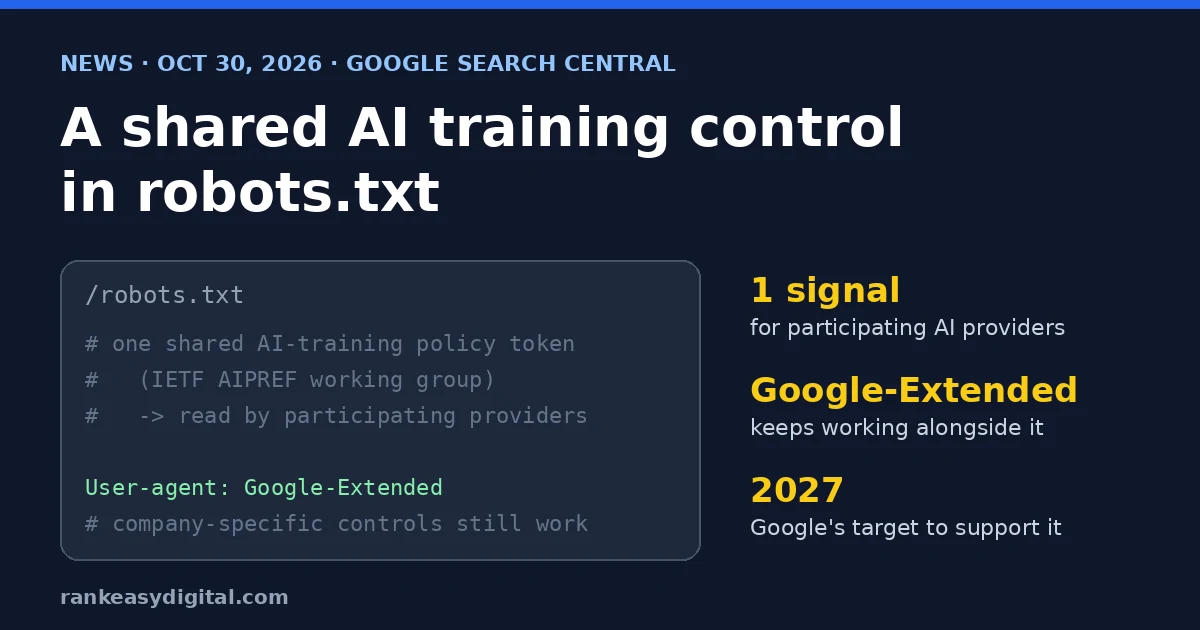
Short answer: On Friday, October 30, 2026, Google published “Supporting a shared AI training control for websites” on the Google Search Central Blog. Google announced its plans to support a shared AI training control in robots.txt: a single “policy token” that lets a website express its AI training preference to multiple participating AI providers in one step. The control is based on work from the AIPREF working group at the IETF. If a site uses the token to opt out of training and does not explicitly mention Google-Extended, Google plans to treat that as a Google-Extended disallow. Company-specific controls such as Google-Extended keep working alongside it. Google says it aims to support the control, along with other AI providers, in 2027.
Honesty / sourcing note
This article is dated October 31, 2026 and is sourced only to Google's October 30, 2026 Search Central Blog post by John Mueller. That post calls the mechanism a draft proposal and a plan. It does not publish the exact token syntax, a launch date beyond “in 2027,” a list of participating providers, or any effect on Google Search rankings, so we state none of those. Sections labeled “RankEasy's take” are our own recommendations, not Google's.
What Google Announced
Google opens the post plainly: “Today, we're announcing our plans to support a shared AI training control in robots.txt.” The stated goal is to help websites “express their AI training preferences across multiple AI providers in a single step.”
Three facts anchor the announcement:
- Where it lives: robots.txt, the same file site owners already use to give instructions to crawlers.
- Where it comes from: work by the AIPREF working group at the Internet Engineering Task Force (IETF), the body that develops many internet standards.
- How it relates to Google's existing control: Google frames it as building on its “long history of providing website owners with clear controls, including through Google-Extended, the AI training control we've offered since 2023.”
How the New Control Will Work
Today, a site owner who wants to state AI training preferences generally has to manage separate instructions for each AI developer. Google's post describes the alternative: “website owners will be able to use a shared ‘policy token’ within robots.txt to set broad preferences across participating AI providers.”
The key sentence for anyone managing a robots.txt file is Google's interpretation rule:
“When a website uses this policy token to opt out of training in its robots.txt file (and Google-Extended is not explicitly specified), Google plans to interpret that as if the publisher had disallowed Google-Extended.”
Google adds that “other AI providers can handle it similarly, making it easy for website owners to opt out across all providers, or to pick and choose.” Note the word can: the post describes what participating providers may do, not a commitment on anyone else's behalf.
Google also says the mechanism gives site owners “the benefit of the AI training definition developed at the IETF while multistakeholder discussions continue on the rest of the AIPREF vocabulary.” In other words, the training definition is the piece being put to use first. Other parts of the AIPREF vocabulary are still under discussion, and the post does not describe them.
Google-Extended Is Not Going Away
The post is explicit that “existing company-specific controls will continue to function alongside this new joint signal.” Google describes the intended layering this way: site owners can “express a broad choice using the industry signal, while also tailoring their instructions to individual AI developers like Google through controls such as Google-Extended.”
Put together with the interpretation rule above, the logic Google describes looks like this:
| What your robots.txt says | What Google's post says will happen |
|---|---|
| Shared policy token opts out of training; Google-Extended not mentioned | Google plans to treat it as if you disallowed Google-Extended. |
| Google-Extended explicitly specified | The interpretation rule applies only when Google-Extended is not explicitly specified, so your explicit Google-Extended instruction is the one that speaks to Google. |
| Google-Extended specifically allowed | Google says such sites “are eligible to appear in responses and receive clicks via grounding in Gemini Apps.” |
| Other AI providers | Google says they “can handle it similarly.” Their behavior is up to them; the post does not name them. |
Why Google Says It Is Doing This
Google says the draft proposal “reflects feedback from publishers, civil society groups, regulators and other stakeholders that have called for industry-wide controls on AI training.” It argues that support across major AI providers “will enable a future standard that is cross-industry, robust, and durable.”
The post also ties the proposal to European rules. Google says it is “consistent with the EU Code of Practice for General Purpose AI (GPAI) Model Providers under the EU AI Act that recognizes robots.txt as a primary method for web publishers to express machine-readable preferences.”
Google says it will “continue to work with these stakeholders to refine and standardize this through the IETF working group,” and that it aims “to support this new control along with other AI providers in 2027.”
What Google Did Not Say
For a news item like this, what is missing matters as much as what is there. The October 30 post does not:
- Publish the exact name or syntax of the shared policy token.
- Give a specific launch date. The only timing is the aim to support it “in 2027.”
- List which other AI providers will participate.
- Say anything about Google Search rankings, AI Overviews, or AI Mode.
- Ask site owners to change their robots.txt today.
Any article that hands you a ready-to-paste token line or promises a ranking effect is going beyond the source. We will update this page when Google publishes more.
What This Means for Site Owners (RankEasy's Take)
The following is our own reading for small and local businesses, not Google guidance.
1. Nothing breaks today, so do not rush an edit
Google calls this a plan with a 2027 target, and company-specific controls keep working. If your robots.txt already reflects the choice you want for Google-Extended, there is no announced reason to change it now. A hasty edit to robots.txt carries its own risk: a typo there can block crawlers you actually want.
2. Decide your AI training position on purpose
The value of a shared token is that one line can carry a broad preference across participating providers. That only helps if you have made the decision. For most home-service and local businesses, the commercial question is visibility: do you want your pages to be eligible to show up in AI answers, or is protecting the content more important? Google ties one concrete benefit to explicit permission: sites that specifically allow Google-Extended are eligible to appear in responses and receive clicks via grounding in Gemini Apps.
3. Watch the interaction between a broad opt-out and Google-Extended
Under Google's stated rule, a broad training opt-out with no Google-Extended line would be read as a Google-Extended disallow. If you later want to opt out broadly but stay eligible for grounding in Gemini Apps, the post's layering suggests the answer is an explicit, Google-specific instruction alongside the broad signal. Confirm the final syntax once it is published before relying on that.
4. Know who controls your robots.txt
Many small businesses run on website builders, themes, or plugins that write robots.txt for them. Before 2027, find out who can edit yours and whether your platform will expose a setting for the shared token. That way the decision stays with you instead of a default.
5. Keep the fundamentals that make you citable
A robots.txt preference is a permission signal, not a ranking or citation strategy. Being chosen as a source still depends on having clear, accurate, well-organized pages that answer real questions. That means service pages with specifics, consistent business details, and content that states facts plainly with sources. Those habits are worth building regardless of what you decide about training.
For SEOs and Agencies: A Short Checklist
Again, our recommendations, built only on what the post states:
- Inventory each client's current robots.txt and note whether Google-Extended is mentioned, allowed, or disallowed.
- Record each client's intended AI training position in writing, so the 2027 change is a quick decision rather than a scramble.
- Flag any client that wants a broad opt-out but also wants eligibility for grounding in Gemini Apps; they will likely need both a broad and a Google-specific instruction.
- Subscribe to the Search Central Blog and follow the IETF AIPREF working group for the final token wording.
- Do not publish token syntax to clients until it is officially documented.
Timeline
- 2023: Google begins offering Google-Extended as its AI training control (per the post).
- October 30, 2026: Google announces plans to support a shared AI training control in robots.txt, based on IETF AIPREF work.
- 2027: Google's stated aim to support the control, along with other AI providers.
Earlier this month, Google's Search Central team also launched curated YouTube learning paths, including a Technical SEO playlist that covers robots.txt. Read our breakdown: Google's New SEO Learning Paths on YouTube.
Frequently Asked Questions
What did Google announce on October 30, 2026?
In the Search Central Blog post "Supporting a shared AI training control for websites" (Friday, October 30, 2026), Google announced plans to support a shared AI training control in robots.txt. It lets websites express AI training preferences across multiple AI providers in a single step, and it is based on work from the AIPREF working group at the Internet Engineering Task Force (IETF).
Is the shared AI training control live now?
No. Google describes it as a plan and a draft proposal. The post says Google aims to support the new control, along with other AI providers, in 2027 and will provide updates on its progress.
How will Google treat the shared opt-out token?
Google says that when a website uses the shared policy token in robots.txt to opt out of training, and Google-Extended is not explicitly specified, Google plans to interpret that as if the publisher had disallowed Google-Extended.
Does Google-Extended still work?
Yes. Google says existing company-specific controls will continue to function alongside the new joint signal, so site owners can set a broad choice with the industry signal and still tailor instructions to individual AI developers through controls such as Google-Extended, which Google has offered since 2023.
What happens if I explicitly allow Google-Extended?
Google says websites that specifically allow Google-Extended are eligible to appear in responses and receive clicks via grounding in Gemini Apps.
What is the exact syntax of the new policy token?
Google's post does not publish the token's exact syntax, so we do not state one. Google says it will keep working with stakeholders to refine and standardize the proposal through the IETF working group. Watch the Search Central Blog and the IETF AIPREF working group for the final wording.
Does this change how Google ranks my site in Search?
The announcement does not say anything about Google Search ranking. It is about AI training preferences and Google-Extended. We do not claim any ranking effect in either direction.
Who wrote the announcement?
The post is credited to John Mueller, Google Search Advocate.
Source
Google Search Central Blog, “Supporting a shared AI training control for websites”, Friday, October 30, 2026, posted by John Mueller, Google Search Advocate. Read on October 31, 2026.
Not Sure What Your robots.txt Says About AI?
RankEasy will review your robots.txt and AI visibility setup and tell you what to keep, change, or leave alone, with sources.